Kakao achieves 'RE100' by converting power used in Jeju Office to renewable energy

- Kakao joined hands with the IT social venture ‘60Hertz’ to purchase renewable energy certificates (REC) produced by civic associations.
- Kakao converted 100% of the electricity consumed in the Jeju office to solar energy with plans to transition to 100% eco-friendly energy by 2024
[February 1, 2023] Kakao is implementing ESG-responsible management by executing actions that respond to the climate crisis, as based on their “Active Green Initiative” announced last year.
Kakao (CEO Hong Euntaek) announced on February 1 that its Jeju office is now functioning 100% on renewable energy through the renewable energy certificates (REC) the company purchased following a business agreement that was executed with 60Hertz (CEO Kim Jongkyu), the energy IT social venture. RE100 is a global initiative that companies join voluntarily to respond to climate change by using 100% renewable electricity.
Through the business agreement Kakao signed with 60Hertz, Kakao purchased renewable energy certificates (REC) produced by civic associations across the country that belong to the National Association of Civil Development Cooperatives. 60Hertz is a social venture that contributes to lowering carbon emission by providing a solution that can predict the amount of power generated by renewable energy, such as solar and wind power. The company also introduced a renewable energy subscription service “Monthly Sunshine and Wind”. The Civil Development Cooperative is the largest energy cooperative in Korea that consists of 90 civic associations and 10,000 members who operate around 240 solar energy-producing power plants.
Kakao purchased sustainable energy that was directly produced by citizens to widely promote the social value of renewable energy. As a result, Kakao was able to procure all the power consumed in 2022 in Kakao’s Jeju office with eco-friendly solar energy.
Starting with the Jeju office’s full conversion to renewable energy, Kakao will gradually increase its renewable energy procurement. Kakao plans to convert 60% of the total electricity used for operations to eco-friendly energy by 2030, and then to 100% by 2040.
Hoon-Young Park, head of Kakao’s Environmental Management Task Force, said, “The Jeju office’s complete conversion to renewable energy has an important meaning for carbon emission reduction, just for the company, but also at a social level”, and added, “In the future, Kakao, users, partners and every member of society will expand their interest in eco-friendliness, which will lead to various impacts that will result in a variety of activities people can relate to and participate in together.”
Meanwhile, in April 2022, Kakao established a principle to respond to the climate crisis and announced the Active Green Initiative which contains the company’s will to play an active role in solving the environmental crisis. Kakao presented a goal to go beyond reducing carbon emission in the company’s offices and contribute to the sustainability of society by utilizing Kakao’s diverse services that are used by the entire country. The company also aims to achieve Net-ZERO, or zero carbon emission, by 2040. In addition, Kakao established three principles, which are ▲ Inside Kakao: Reduce carbon emission inside Kakao, ▲ Through Kakao: Kakao’s partners/users contribute to the environment while using Kakao services, and ▲ With Kakao: Practice eco-friendliness through cooperation with a variety of stakeholders. Through these efforts, Kakao was recognized for its continued ESG management activities. Kakao was included in the Dow Jones Sustainability World Index (DSJI World) for two consecutive years, acquired an A in the integrated category of the KCGS ESG Evaluation announced by the Korea Corporate Governance Service (KCGS), and acquired an AA rating from the MSCI ESG Evaluation. (End)
- Press Release Kakao Reports KRW 2.1 Trillion in Revenue and KRW 277 Billion
in Operating Profit for Q2 2026 #kakao#revenue#Q2 2026
 - Press Release Kakao Open-Sources Four SLMs on Par with Global Models
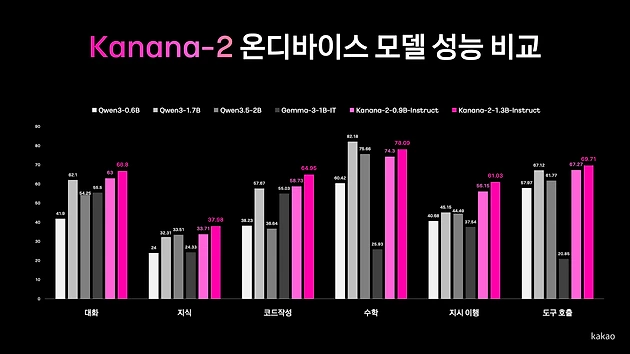 #kakao#Kanana#Hugging Face
 - Press Release Kakao Advances Speech Generation Technology for Its In-House Omni AI Model, Kanana-o
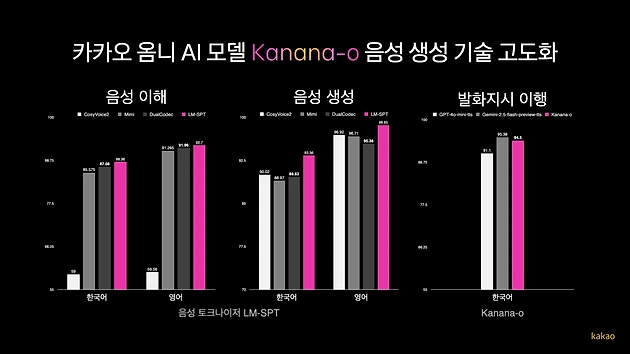 #kakao#Kanana
