'Research Life TF' digitally transformed taxis

In early 2014, Kakao was turning its attention toward out of the mobile world. The merger with Daum Communications announced previously on May 26 catalyzed building momentum. Kakao had built its presence by succeeding in what they set out to do in a row, such as KakaoTalk, Plus Friends, Emoticon, KakaoStory, Kakao Games, Kakao Friends. But the company lacked in human resources, know-how, many other parts now that it had grown dizzyingly within a short time. However, Kakao's chronic thirst was expected to be quenched by the merger with Daum Communications. All eyes in and out then were on what synergies Daum Communications diverse businesses and Kakao's mobile social graph would produce jointly.
# From online to offline
On June 12, 2014, Kakao organized the 'Research Life TF' led by Krews from Lotiple, Thinkreals, and Sunnyloft that Kakao had acquired before. It was not targeting any specific business items. Lotiple had a full understanding of offline business since it had operated a location-based mobile commerce business before the acquisition. 'Thinkreal' also had hands-on experiences in curating social commerce information and rendering information-sharing services such as good restaurants. John (previously CEO of KakaoMobility, and currently Head of New Business Development) from Sunnyloft, a social dating service provider, was appointed as the TF lead.

Abundant O2O (Online to Offline) business ideas came out of their shared experiences. At that time, 'O2O' sounded unfamiliar, and the market cap of O2O titans like Uber and Airbnb were then evaluated as one or two-tenths of the current values of 100 trillion Won. Even it was common to see people misread 'O2O' as 'zero two zero.'
They couldn't decide what items they should pursue, but it was crystal clear where such items should be geared toward. They all agreed that Kakao should turn its direction toward 'life platform,' away from 'mobile information platform,' while seeking out its future cash cows. They came up with various ideas such as chef dispatch, meal kit, food delivery, housekeeper, laundry, self-storage, resale, subscription services, etc.

# The start of Project 'Uyuni'
In the second month of its commencement, the TF team chose the Taxi service as its new business item. The item was first proposed at the Focus Meetings, which were held regularly since Kakao and Daum Communications decided to merge. Andres said that "they started the initial planning phase without any great expectations." No one had expectations for network effect to spread offline as much as they witnessed online. Local taxi operators were wielding hegemony in the relevant ecosystem. Call-taxi operators who had formed their own market were also another reason for lowering expectations.

The TF team set out to persuade stakeholders based on reviewed findings. Unlike leisure time, 'bare essential time' for sleeping, eating, working, or moving was proved to have been rarely affected by digital transformation. Regardless of region, sex, and residence, all the men and women traveled at a certain level. Taxis were one of the most frequently used means of transportation. Service providers could guarantee 'standardized' service with driver certification. All these were enough to motivate the company.
'Let's do it!' Krews were all on common ground. Some local business team officers from Daum Communications that were to be merged also joined the TF team. As a result, there were about 10 TF members. Like that, KakaoTaxi started off the Project 'Uyuni' without any transportation business experts inside. The project was named 'Uyuni' that seemed not particularly related to taxi or travel. It was because the developers in the team wished for 'a workshop in the Uyuni Desert as a reward.'
In later 2014, call-taxis were operated on the principle of users calling call centers to request a ride, call center officers checking requestors' location and inputting destination into navigation system installed in taxis. Drivers usually signed a three-year contract with a monthly fee of KRW 30,000 or more for navigation and paid a separate call fee. After deciding to bring forward new business, they first contacted call-taxi operators as potential partners. Several large corporate affiliates or local business operators occupied the call-taxi market, which was less than 5% of the total traffic volume.
"'Should anyone make a phone call in the mobile era?' 'Is the navigation fee appropriate?' 'Isn't the information distorted while being passed to the call center by passengers and exchanged between the call center and taxi drivers?' 'Isn't it that call taxi business stop growing at a level of 5% of the total traffic due to inconveniences on both parts - passengers and taxi drivers? We met call-taxi operators to discuss collaboration, which only left us many questions. They commonly asked us to make user's apps only while reacting against handing over supplier areas. And, we got to have the measure of reality: Kakao should seek its own business opportunities to foster tangible innovation." That's John's remembrance in October 2014.
# 'Internet? I don't search the Internet. KakaoTalk? I use it to see my granddaughter's photos.'
The decision to solve supplier-user problems altogether and firsthand left Kakao, an O2O business operator, with an unexpected mountain to climb. First of all, more than half of taxi drivers did not use a smartphone. Moreover, 70 percent of the total taxis were privately owned. There was no way that Internet business-oriented Krews would know about any conventional channels independent taxi drivers were utilizing to gather and communicate together. Krews scouted around online communities, morning soccer clubs, taximeter stores, and many other places known for drivers' communities, based on the advice from Krews, whose family members were in the related business. (* Drivers change receipts or set meters at a taximeter store.) Another problem was that older taxi drivers and transport operators regarded the digital environment as 'none of their businesses.'
John recalls when he toured the taxi transport business associations across the country and solicited their participation.
"I found union president offices across the country were all quite similar. Taegeukgi and union flags were hung together on the wall behind their seats. Orchid flowerpots on the desks and dark green winceyette tablecloth on the wood tables. What caught my eyes most was all those offices had no computers at all. What an extremely unplugged environment! Under these circumstances, an explanation 'what mobile business is or how O2O business would be in the future didn't work at all. Thus, I put it as plainly as I could. We were the company that made KakaoTalk where they received their granddaughters' photos, and we would make it easier to call a taxi for KakaoTalk users, the majority of Korean people."
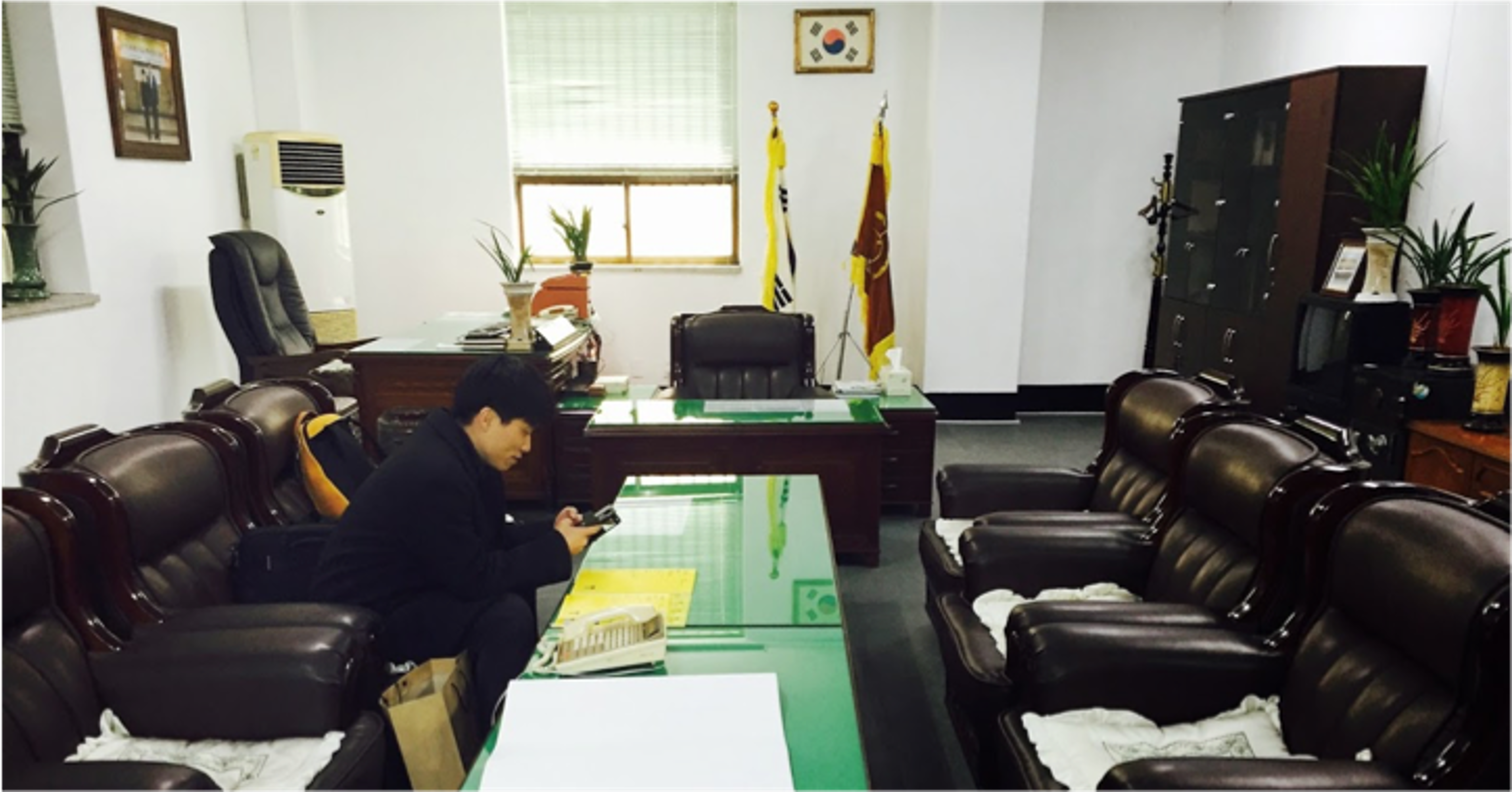
In later 2014 and early 2015, one group of Krews was busy developing apps for passengers and drivers. The other group traveled all over the country to attract the drivers.


#Because it was our first experience...
The KakaoTaxi business was located in an 'unknown area' where the Internet and mobile couldn't reach. That's why there existed a unique development process that Kakao hadn't experienced in their previous services.
For example, they had to develop drivers' apps that were not connected to KakaoTalk accounts. Those who had ever used the Kakao services would take 'Login with KakaoTalk' for granted, like water and air. Also, logging in with KakaoTalk had many pluses in that Kakao could enhance user convenience and ensure efficient maintenance. Ironically, Krews decided to remove this too good method at the stage of logging into a driver's app to optimize user convenience. The Kakao Driver app had drivers use their mobile phone numbers as ID and birthdate as passwords for those unfamiliar with using their smartphones. Krews conducted intensive examinations of submitted taxi driver's licenses.
Taxi drivers who were senior smartphone newbies had to use the app running on a smartphone mounted on the dashboard. Moreover, different strokes for different folks-drivers preferred different dispatch methods by region and personal taste. Considering all these characteristics, Krews developed dispatch algorithms calculating efficient travel routes, not beeline distance, while designing an extremely simple User Interface with huge font.
Ross, who developed an Android app for KakaoTaxi, said, "It was technically difficult to solve the problem of dispatching and guiding vehicles that could reach passengers while giving priority to drivers with high ratings. That's because more than 200 taxis nearby must be detected when one passenger requests a ride. To put it another way, it was a problem that required hundreds of millions of calculations per day on a national level."

In the early days, the KakaoTaxi team put in a great deal of effort for a long time to solve this problem. Daum Communications' map data, which was not in Kakao, was a great help. That was the initial appearance of 'KakaoT,' which has now matured into a comprehensive and mostly automated mobility platform based on deep-learning.
An amazing collaboration also took place. The first released KakaoTaxi app didn't have a navigation function, but on the fourth day of its release, Krews judged that 'it would not work at all.' "How about incorporating Kimgisa Navi?" Only two hours after that idea coming up, Ross finished decompiling and applicability test. John contacted the 'Kimgisa team,' a navigation startup with which he had an 'acquaintance,' to explore the possibility of collaboration. Both sides' neither questioned nor nitpicked.' Immediately, they opened API (Application Programming Interface, where developers can implement and control functions provided by OS or programming languages for an application program.) They developed the new app for three days and nights from Thursday, Friday to Saturday, and launched it on Sunday. Ross remembered the moment, "What moved the two companies was a pure question. 'What would be best for users?' When we look back now, it's hard to believe that the two moved so fast without even signing a contract." After confirming the ultimate user orientation, both companies later reached the point of deciding on M&A.
#The birth of call-taxi with 'profile photo'
In later March 2015, a meeting on securing server resources was held ahead of the app launch. Server capacity is an important issue related to how much real-time traffic can be processed. Krews predicted that there would be about 20,000 KakaoTaxi calls per day, in the beginning, considering that the then total number of call-taxis in Korea was 200,000 per day. They guessed wrong in a 'good' way. Driver members whom Krews had secured by scouting around 250 taxi companies in Seoul and local taxi associations across the country throughout the winter handled user calls without any difficulty. The number of participants in the ecosystem exponentially increased while the app was going viral - 'The app is awesome.' The team had to purchase additional servers in bulk only in a month and a half.
As an unprecedented ecosystem touched off a boom, a new marketing model emerged in the mobility industry, focusing on the role of test-drive platform. That is, if a passenger requested a ride, KakaoTaxi sent a test-drive car suitable for the passenger and allowed him/her to travel or even drive to the destination for free. When automakers were not imagining the contact point with the mobility platform, Kakao proposed this type of test drive model. Most imported car brands successfully promoted their new cars, starting with Volkswagen in July 2016.
"The marketing campaign was very well-received by consumers in that imported cars provided a free taxi service and gave a chance to test-drive. In fact, we didn't have enough resources inside, so we manually made all the statistics pages and dispatches. But the repercussion effect was seismic. It was also the first project for us to see the potential for platform monetization. When all the participating brands were selected as best practices by their headquarters, thus the uniqueness and effectiveness of the marketing campaign were well-recognized, all of us felt greatly rewarded," Andres recalled.
As the ecosystem proliferated while exerting a multiplier effect, taxi drivers as a service provider and their families also expressed their affection for KakaoTaxi. They put self-made stickers on their cars to indicate themselves as a participant of the KakaoTaxi platform. For senior drivers who were not good at smartphones, young family members set out to help them set up their KakaoTaxi app, such as profile photos.
Positive vibes for a phenomenal success prevailed. But there was also a negative current inside of Kakao for a while. That was because the dispatch failure rate reached nearly 30 percent in the early days. For an IT company where the failure rate close to 'zero' was received as the standard, it was difficult to accept the consequences. The team was repeatedly told that when it would start monetizing? Behind all these adversities, the driving force to push the team toward the 'super app' came from a lesson by KakaoTalk: 'If users gather, some will stand with money and others will stand with ideas.'
#What has been changed, and what should be changed
Who would have ever imagined that 'profile photos' are displayed upon calling a taxi? Not only the scene of hailing a taxi on the main road but also many things have changed. Shooting a taxi license plate while seeing off loved ones. Embarrassed with the remembrance of leaving something behind in a taxi and frantically calling around to know whereabouts. All these scenes have passed into history. KakaoTaxi is also at the center of the trend that 'monthly paid' taxi system is replacing the 'daily turning over' approach, which has been pointed out as a chronic problem in the industry and the phenomenon that smartphone GPS replaces decades-old taximeters. The mobility business, which was evaluated as a 'weak monetization model,' has been transformed into a super mobility app servicing luxury taxis, chauffeurs, e-bike rentals, parking lots, and shuttle buses.
The three said about what KakaoTaxi has changed and is going to change.
"Immediately after the app launch, I called a taxi on the KakaoTaxi app, and my driver praised the app until he reached the destination, saying, "You're using this app. It is so good, isn't it?” That is one of the happiest moments I will never forget. It was an area that no one had experienced before, so there was a time when we planned and developed the app reflecting only passenger's perspective. Afterward, we started looking into parts of the app from the driver's perspective and reinforced the details. For example, we adjusted the chroma because the liquid crystal in the bright button area would discolor if a smartphone is turned on all day. I think that innovation could have occurred thanks to layers of these hidden efforts."_Ross
"Until the app launch, the driver recruitment fell far short of our expectations. Many pizza coupons for a membership present left so that we had to eat away pizzas as a late-night meal. Krews had to help drivers set up the app, such as installing the app or uploading a driver's license. Right after the launch, all these things started changing just like a lie. Drivers informed their colleagues, one by one, saying, "This app is perfect." I'm honored to contribute to the birth and growth of a service that has caused a seismic change to our society's mobility behavior. I imagine the moment when everyone turns on the KakaoT app when moving somewhere, and everything is solvable on the app."_ Andres
"Due to the COVID-19 pandemic and many other reasons, we couldn't speed up the proliferation of micro-mobility or collaborations with global platforms as initially planned. However, my thought is that the current mobility platform will realize giant and more imagination. That's possible thanks to those updates made once every other day, Krews' enthusiasm of running to any place where taxi drivers gathered even in the cold winter, and their guts that the app would rule the whole country upon the launch. As the former CEO of KakaoMobility, I look forward to seeing the company achieve more things in the upcoming era of autonomous vehicles, or UAM (Urban Air mobility)."_John
- Tech Contents Discover through mobility
Mobility Technology Story #tech#mobility#story#report
